Safe Enough to Try: Our First Attempt at Sociocratic Decision-Making
As part of our April 2026 General Meeting, we tried something we hadn't done before.
Two of our members had raised a proposal that Dwellbeing might become a member organisation of Tyne and Wear Citizens - part of Citizens UK. Citizens UK is the UK’s biggest, most diverse, and most effective people-powered alliance which brings together everyday people and local organisations to build a better, fairer society. With over 500 member organisations and 4,000 trained leaders, it uses community organising methods to build community-led solutions to big and small problems that work for everyone.
Instead of taking a vote on whether Dwellbeing should join Citizens UK as a member organisation, we used a process from sociocracy - consent-based decision-making, which doesn’t ask whether everyone loves an idea, but asks them whether they feel it is safe enough to try and good enough for now. It was the first time we had tried this approach, and this is what happened…
The proposal was emailed with the agenda in advance of the General Meeting and attendees received a printed copy of the proposal at the start of the meeting, with lots of supporting information to help them make decisions. The question we were asking wasn't complicated: should Dwellbeing join Tyne & Wear Citizens (part of Citizens UK) to be stronger within a local alliance of community groups? But behind the question sat a tangle of real concerns that deserved more than a show of hands.
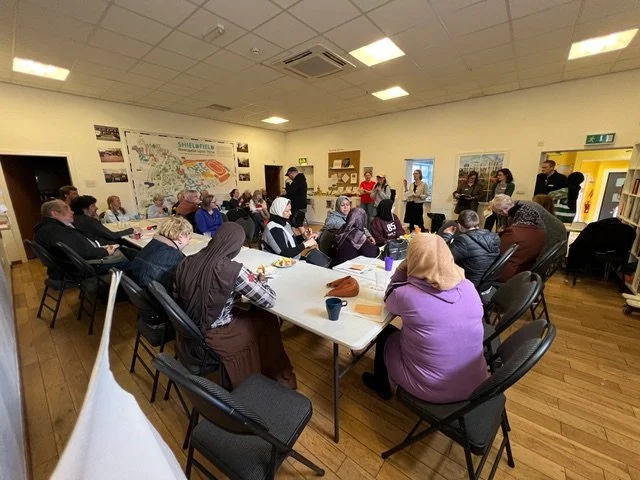
We sat in a large circle of chairs filling the gallery space at SAW, and reminded people of the proposal being considered. To start with, rather than ask opinions, we gathered clarifying questions: What do you need to know so that you can understand the proposal?. Some were practical — about cost, and whether we'd have enough people to represent Dwellbeing meaningfully. Others delved deeper: would this just add more pressure to already stretched volunteers? And were the people in the room truly representative of those most affected by the decision? Once the questions were gathered, we clustered them into themes and asked people with relevant knowledge to respond.
On cost, the price is £810 per year. We heard how other charities typically build membership fees into funding bids rather than drawing on subscriptions. Many see membership as an investment in leadership and organisational capacity rather than an extra drain. On whether we have enough people to represent Dwellbeing, we got a helpful clarification. There is no attendance requirement - it is simply about having enough connected people who can step up at key moments such as Citizen UK assemblies or votes on shared priorities. We just need enough people to act as a bridge between Dwellbeing and Citizen UK. As one person put it, Citizens UK isn't about doing more. It's about doing what you already care about more effectively.
That clarification helped but some people still felt concerns about volunteer time and capacity. Several people spoke honestly about the risk of overloading the same small group of people who already do so much. One person at their first Dwellbeing event, described the environment as joyful but also noted they couldn't see the capacity for the organisation to do more. That kind of honesty was exactly what the process needed.
Before moving to any formal decision, we did a round of quick reactions: What do you think of the proposal? We went around the circle asking people to show thumbs up (generally support the proposal), thumbs down (generally don’t support the proposal), or hands on laps (undecided). This wasn’t asking people to make a decision, just giving us all a chance to look around the room. It was clear there were both those who supported the idea and those who weren't yet sure.
We then moved into a consent round. In sociocracy, consent doesn't mean full enthusiasm. It means getting to the point where you believe an idea is safe enough to try and good enough for now. Going around the circle, we asked each person simply: Do you have any objections?
Some people raised issues and we amended the proposal in the moment to accommodate them. One person said they could only support it if we were very clear about the financial risk. They asked if we could commit for one year only to make sure it wouldn’t damage our finances. They also proposed we review, formally, with the membership and check whether we feel we are benefitting from it, instead of sliding into a “gym membership we never use” situation.
In response, we amended the proposal in the moment - should Dwellbeing join Tyne & Wear Citizens for one year, then formally review its value and practicality before continuing? This kind of small amendment to a proposal is exactly what sociocracy encourages.
Even after this amendment had been made someone still had concerns about capacity and the risk of burning out people who are already giving a great deal. Another raised something harder to resolve in the room: that the people present might not truly represent the residents most directly affected by decisions made in Dwellbeing's name. In cases like this if consent is not reached, sociocracy asks: What are our options for moving forward?
There are options at this stage, they could have involved discussing further in a smaller group, attending Tyne & Wear Citizens events as guests before committing, or rework the proposal with a wider group of people and bringing it back to a future Dwellbeing meeting for further consideration. We agreed that the proposal would be reshaped and a wider consultation would be considered. Rather than leaving this as a vague “someone should consider this” we went around the circle again asking: Would you like to be part of reshaping this proposal or finding out more information? - several people said yes.
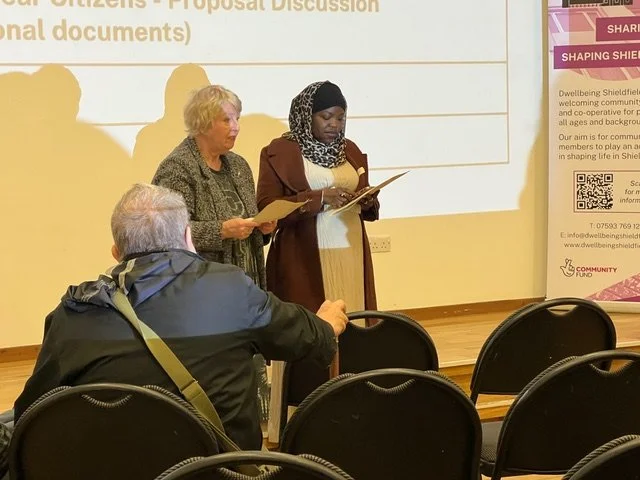
By the time we closed, we had not yet decided to join Tyne & Wear Citizens but we had tried a new way of making decisions together. It was at times messy and not always easy to follow, but we used questions to build shared understanding, took a temperature check across the room, amended a proposal in real time, and made tangible progress together.
A small working group will now dig into the details: costs and how they might be funded, what a realistic review process would look like, and how to bring more voices into the conversation. They'll also explore whether there are opportunities to attend Tyne & wear Citizens events as guests, so people can experience what membership might look like in practice. The aim is to bring a reshaped proposal back to a future Dwellbeing meeting, where we'll go through the process again with a wider group of people.
If you'd like to be part of the working group, or just want to know more, get in touch.
What did we learn?
This was our first attempt at this proposal-based consent decision-making process. In the weeks following the General Meeting we have taken time to reflect on feedback and conversations so that we can make the most of it as a learning opportunity. These are our key learning points.
New processes need practice
For example, with practice we might better understand the difference between clarifying questions and objections, or when it might be better to split into smaller groups instead of speaking in rounds. There are lots of groups and resources out there to help us learn more. Here are a few:
And with practice, the consent decision making process can become quick, effective and joyful.
Make more time and support for producing proposals before they are brought to a meeting
We could adapt the format of our ‘Shaping Shieldfield Sessions’ (previously used to develop Get Crafty and Get Chatty) into a process of picture forming and proposal shaping. This would allow more people to contribute to proposals and would build core support before proposals are brought to a General Meeting.
Who decides?
There were lots of Dwellbeing members in the meeting but many didn’t see themselves as being appropriate decision-makers if they are not Shieldfield residents. This reflects the ethos at the heart of Dwellbeing - to be genuinely led by residents - and a desire to develop more ways for residents' views to be prioritised in our planning and decision-making. This key learning will be taken forward into future members' activities such as welcome events, working group meetings and Shaping Shieldfield Conversations over the coming year.